
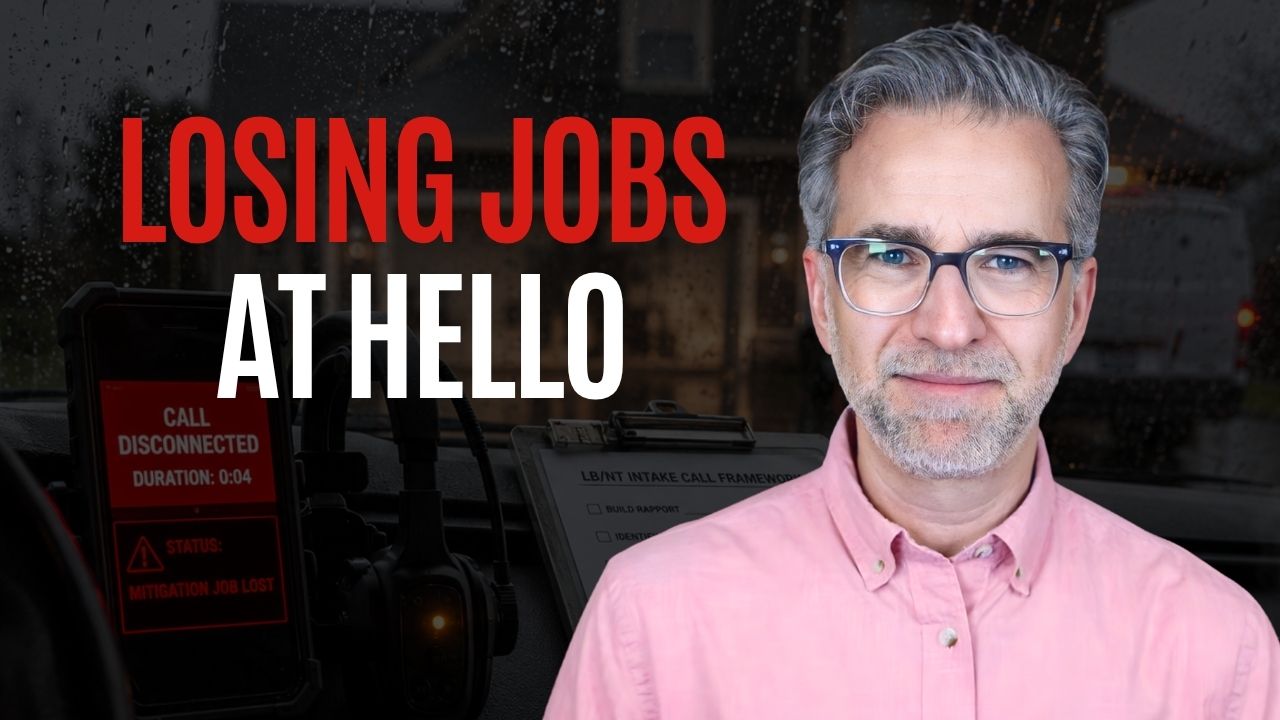
Why Restoration Companies Lose Water Damage Jobs on the First Phone Call
May 26, 2026You're paying for leads, paying for SEO, paying your team, and then losing the job in the first 30 seconds of the call. Here's the fix.
Why Restoration Companies Lose Jobs on the First Phone Call (And How to Fix It)
If you’re a restoration business owner and you want more mitigation jobs—who doesn’t? Hang in here with me for a few minutes.
Grab a notepad. I’m serious.
I want to challenge you to actually take action, not just watch this and think, “That’s a good idea.” If you’re anything like me, it’s easy to watch something, agree with it, and then move on without doing anything.
Let’s change that this time. Take a few notes as you go.
I’ve listened to hundreds of intake calls for my clients—calls from homeowners dealing with water damage, fire damage, mold, and other emergencies. After hearing that many calls, certain patterns start to stand out.
And what I hear way too often is companies blowing it on the very first phone call.
They never even get the opportunity to go help the customer because the call goes poorly.
That’s what I want you to avoid.
Think about how much time, money, and effort go into making your phone ring.
You’re paying for Google Pay-Per-Click.
You’re paying for Local Service Ads.
You’re paying an SEO company to help you rank organically.
Maybe you’re rewarding your team for getting Google reviews.
You might be paying plumbers for referrals.
Maybe you’ve got a sales rep out there building relationships.
All of that effort is focused on one thing: making your phone ring.
Then someone finally calls because they’ve had damage in their home and they need help.
And what happens?
Too often, the opportunity gets lost right there on the phone.
The Three Things Every Intake Call Needs
After listening to hundreds of calls, I’ve found that three elements need to be present in every intake conversation:
- Empathy
- Confidence
- A Sense of Urgency
Sometimes they’re there. Sometimes they’re not. And sometimes they’re there—but done poorly.
And before you say, “That doesn’t happen in my company,” I want to challenge you.
There’s an easy way to find out.
Start listening to your call recordings.
Prove me wrong. I hope you do.
But even the best companies I work with learn something when they start reviewing calls.
1. Empathy
Imagine a homeowner calling after they’ve just discovered water damage.
They might say something like:
"Hi, I just got home from work and my house is a mess. There’s water everywhere and I don’t know what to do."
Now think about the two ways that call could be handled.
One response might be:
"Oh my gosh, I’m so sorry that happened."
Another response might be:
"Okay. What did you say your name was? Let me start getting some information from you."
Which one feels better?
If I’m the homeowner, I want to hear that the person on the other end of the line actually cares.
If I don’t feel that empathy, I’m immediately wondering if I called the right company.
2. Confidence
The next thing a homeowner wants to hear is confidence.
Something like:
"No problem. We’ve got you covered. Our team handles situations like this all the time. You called the right place."
That kind of reassurance matters.
They’re dealing with a stressful situation, and they want to know they’re talking to someone who can help solve the problem.
3. A Sense of Urgency
This is the one that’s missing most often.
Here’s how the conversation sometimes goes:
The intake person asks, “Have you called your plumber yet?”
Or, “Have you called your insurance company yet?”
If the homeowner says no and you let them hang up without scheduling a visit, there’s a good chance you just lost the job.
Here’s why.
If they call their plumber, the plumber will probably refer the restoration company that’s paying them the most.
If they call their insurance company, they’ll likely get referred to a preferred vendor.
Either way, you’re out of the picture.
Instead, the goal of that call should be simple:
Get the job scheduled.
You can still ask those questions, but the message should sound more like this:
"Go ahead and call your plumber, but we’re already on our way."
If the plumber suggests another restoration company, the homeowner can simply say they’ve already got someone coming.
You can also advise them not to rush into calling their insurance company.
Let them know you’ll take a look first. It might be something that falls under their deductible, and it may not even make sense to file a claim.
You’re not giving insurance advice—you’re helping them understand their situation before making a decision.
But again, the key goal of that call is getting the appointment scheduled right then and there.
Not later.
Not after someone calls them back.
Right then.
Because once they hang up, your chances of getting that job drop dramatically.
A Simple Framework to Improve Your Calls
If you want to improve how your team handles intake calls, here’s a simple framework I like to use.
It’s one of my favorite business acronyms: LBNT.
It stands for:
Like Best, Next Time
Here’s how it works.
Listen to a recorded call with your intake team member and ask two questions:
- What did we like best about that call?
- What would we do differently next time?
If you do that consistently—over and over again—your team will keep improving.
And as your calls improve, you’ll get more scheduled appointments.
More appointments lead to more signed jobs.
One More Acronym I Love
Before I wrap up, I mentioned that LBNT is my second-favorite business acronym.
My number one favorite is DSO, which stands for Days of Sales Outstanding.
It’s simply a measure of how fast you’re collecting money in your business.
If you want to learn more about that, I’ve got another video that goes deeper into it.
Final Thought
If you’re a restoration business owner who wants to become more profitable, reduce the chaos in your business, and build a company that’s actually sellable someday, I’d love to talk with you.
We’ll walk through some ideas, I’ll give you a few action items, and you’ll walk away with some practical steps you can start using right away.
Even if you’re not ready for coaching, it’s still a great conversation to have.
I’ll see you in the next video.
Get Your Restoration Business
In The Best Shape of Its Life
with the help of a guide dedicated to your success.
Written by