
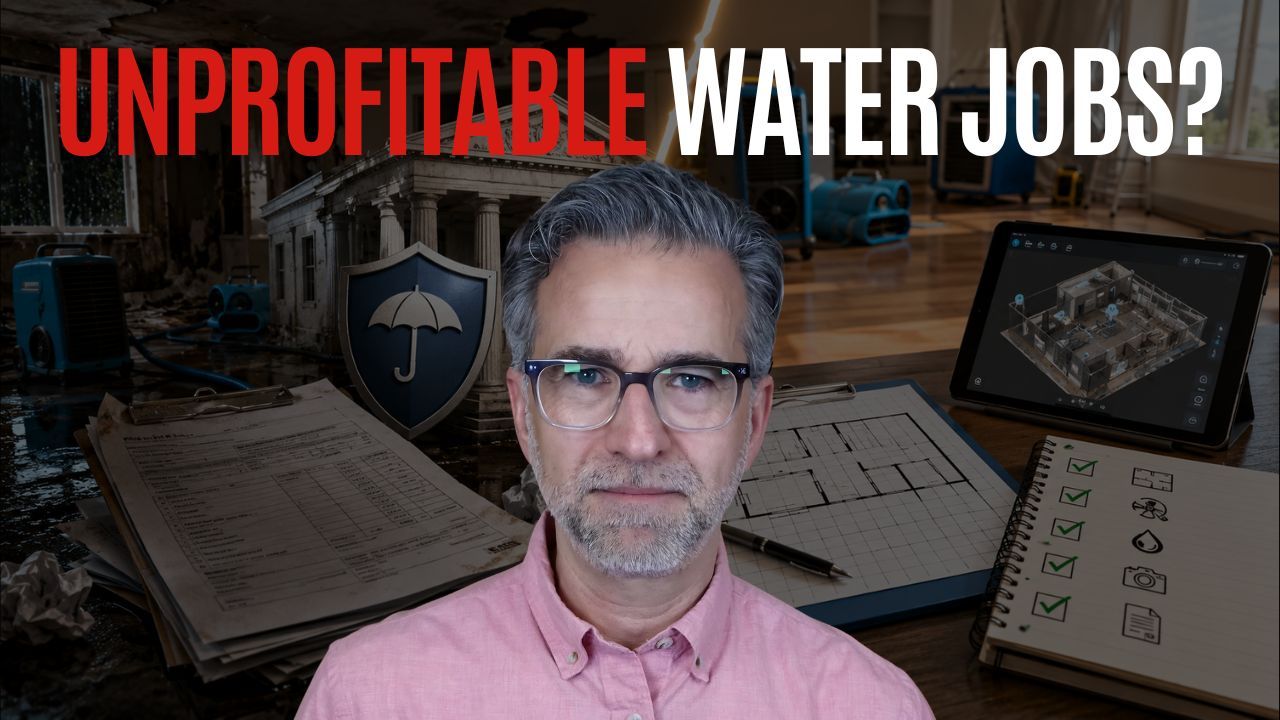
Why Water Damage Jobs Are So Hard to Make Profitable
May 12, 2026Most restoration companies lose profit long before the estimate is approved.
If you're a restoration business owner and you hear yourself or your team saying, "We just can't be profitable because of these darn insurance companies," I want to challenge you.
I want to ask you a couple of questions about your process. Take some notes and hang in there with me. I work with restoration businesses all over the country, ranging from startups to eight-figure, multi-office operations specializing in water, fire, mold, asbestos, and reconstruction. I've been doing this since 2009, and I can tell you that the most profitable businesses are doing something differently than the least profitable ones.
Here is what they are doing.
- Sketch and Scope on Day One
Some people do it old school with a piece of paper, a tape measure, and graph paper. Others use technology like Matterport, DocuSketch, or LIDAR with iPads and iPhones. It doesn't matter.
If you get your sketch and scope done on day one and start writing the initial estimate on day one or the morning of day two, all kinds of things become possible. You get to see how the job is being set up right from the start:
- Are we missing equipment?
- Are we missing specialty equipment?
- Are we missing the documentation we need to justify that equipment?
Are we doing the right things for the customer? If we are, did we capture them on the scope so that we actually get paid? So often I see unprofitable jobs because of poorly written scopes. Usually, it's because the scopes are being written days after the job is done. Sometimes even worse. When scope notes are bad, people end up going back out or looking at photos trying to recreate what a technician did a week or two ago.
This is a formula to be unprofitable, and you can't blame the insurance company for that. That's on you. Fix that process. Get out there on day one and sketch and scope. Don't say you're too busy; you're going to be much less profitable if you wait.
- Give Your Team a Target
When you sketch and scope immediately, you'll know the rough overall price for that job. It won't be exact, but you'll have a number. Then, you can share the budget with your team.
They need to know how long they have to produce the job and how many labor hours should be on it. If you don't give your team the target, how could they possibly hit it?
Just by knowing their labor budget, they have a much better chance of success. If you don't have a target labor percentage for your jobs, that's another thing you can't blame on the insurance company. Set a target. Share it with your team right from the start so they have an opportunity to hit it. You are going to be amazed at the difference in profitability if you just do those two things.
The LBNT Review
Doing these two things allows you to do one more thing: look at the job afterward. Imagine you're the technician and I'm your manager. We can sit down after the job is done and look at the file using a simple business acronym I love: LBNT.
- LB: What do we Like Best about how that job was run?
- NT: What are we going to do differently Next Time?
Spend a few minutes looking at the job file, the scope, the documentation, and the Xactimate estimate. Figure out what could have been done better, and reinforce the positive feedback about what went really well.
Get More Profitable
If you do these things, you will get more profitable. There's almost no way you can't.
If you want to learn more about this or want to get on a call with me, just book a call and we'll talk through it. I guarantee you're going to come away with action items that help you increase profit, reduce the chaos in your business, and help you build a more sellable business.
Get Your Restoration Business
In The Best Shape of Its Life
with the help of a guide dedicated to your success.
Written by