
The Restoration Owner Blind Spot That's Costing You Money
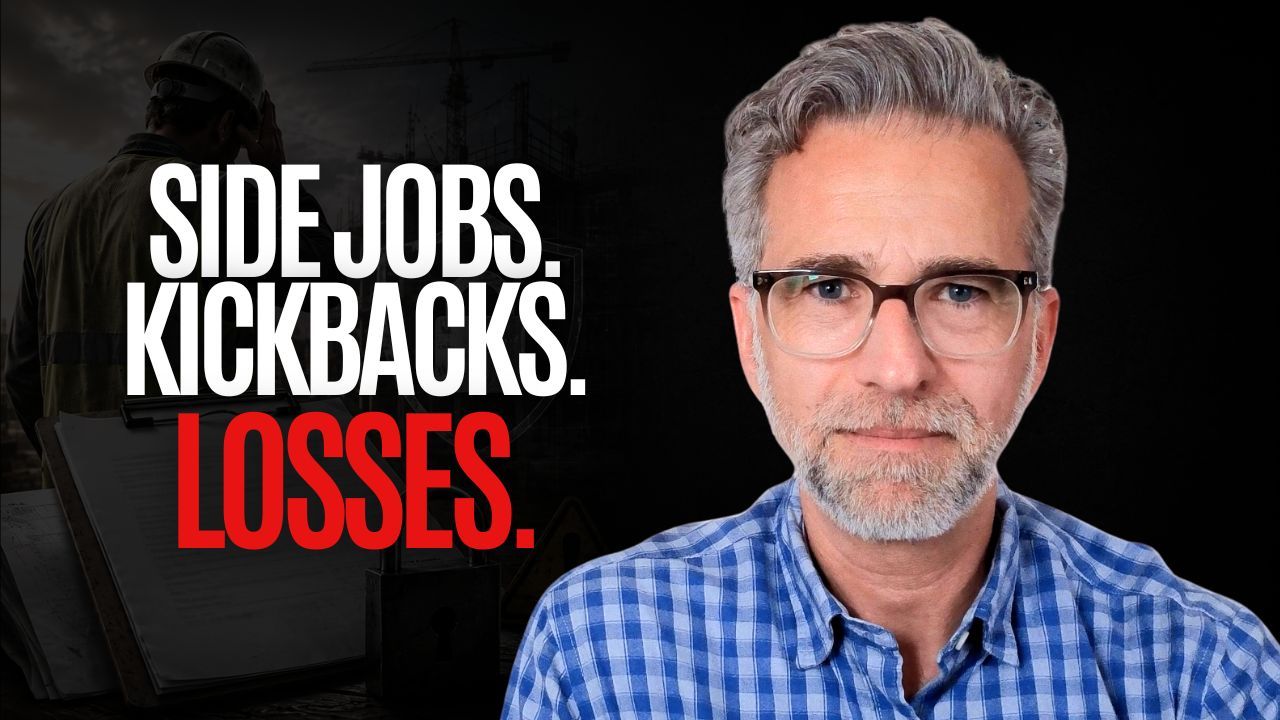
Jul 30, 2026Side jobs, subcontractor kickbacks, cash app schemes. If you don't have strong controls, you don't even know if it's happening.
I've been hearing too many stories lately.
A project manager receiving kickbacks from a subcontractor. A customer paying an employee directly instead of the company. Materials showing up on jobs but not on invoices. Company credit cards being used for personal expenses. Supplements that never get submitted. Change orders that never get signed.
Some of these stories involve dishonesty. Many don't. But almost all of them have one thing in common.
The owner had no idea it was happening.
That's what got me thinking about this article.
Before we go further, if you're new here, I help restoration business owners get more profitable, reduce the chaos, and build something they can sell for a lot of money someday when they decide to move on.
One of the stories that really got me involved a reconstruction manager who was collecting cash payments from customers and accepting electronic payments through an app on his phone. To hide what he was doing, he was marking jobs as lost in the CRM so nobody in the office would be expecting revenue from those jobs.
Obviously, I'm disappointed in the employee. But if I'm being honest, I'd probably be even more disappointed in myself. Not because I took the money. I didn't. Not because I caused the behavior. I didn't do that either. I'd be disappointed because my controls weren't strong enough to catch it sooner.
Maybe that's not the healthiest way to look at it, but it's how I've always viewed business ownership. If something isn't going well in the business, I start by looking in the mirror. If things are going well, I tend to give the credit to the team. I've always felt a responsibility to protect the business, my family, my employees, their families, and our customers. To me, that's part of the job.
One of the things I hear all the time is, "Scott, I trust my people."
Good.
I trust people too.
Looking back at my own restoration company, I was actually very fortunate. I experienced very little dishonesty over the years. Most of the controls we built weren't there to catch thieves. They were there to verify that things were happening the way we thought they were happening.
Trust is important. Trust just isn't a control system.
When I hear an owner use trust as a reason not to review reports, not to look at job profitability, not to verify collections, or not to build controls, what I really hear is a lack of discipline. That may sound harsh, but I believe it's true. People make mistakes. Good people make mistakes. Great employees make mistakes. People get overwhelmed. People cut corners. People avoid difficult conversations. And every once in a while, you run into someone who is simply dishonest.
Controls help with all of those things.
A few years ago, I had a client who started digging deeper into job costing and reconstruction margins. Before we worked together, the company wasn't doing a very good job of budgeting jobs, and the bookkeeping system wasn't giving the owner meaningful visibility into profitability. As we started looking at the numbers together, it became obvious that margins were nowhere near where they should have been.
The reconstruction manager pushed back hard. He told the owner that I didn't know what I was talking about. He insisted the margins I was suggesting weren't realistic. Eventually, the owner invited him onto one of our coaching calls. I asked a lot of questions. The manager got defensive. Very defensive.
Not long after that, the owner started uncovering what was really going on. Side jobs. Side deals with subcontractors. Inflated invoices. Subcontractors helping with the manager's personal projects while overbilling company jobs. The guy had built a pretty good system for stealing from the company.
The interesting part of that story isn't that he was stealing.
The interesting part is how he got caught.
The owner didn't catch him because somebody turned him in. He didn't catch him because a subcontractor grew a conscience. He caught him because he started paying attention. He started reviewing margins. He started asking questions. He started looking for explanations when the numbers didn't make sense.
The theft was the symptom.
The lack of visibility was the disease.
Not every story involves dishonesty, though.
I have another client who recently lost a reconstruction manager. The guy wasn't stealing. He was simply overwhelmed. He wasn't budgeting jobs properly. He was leaving things off estimates. He was assigning work to subcontractors for amounts that made no sense. He was dropping balls all over the place. Eventually, things got so bad that he simply stopped showing up to work.
Different story. Different person. Different outcome.
The company still got hurt.
That's one of the reasons I think owners sometimes focus too much on fraud and not enough on controls. Whether the problem is dishonesty, incompetence, overwhelm, lack of discipline, or simple human error, the solution is often the same. Better visibility. Better accountability. Better controls.
One of my favorite sayings is that micromanagement gets a bad rap.
I say it jokingly, but there's a little truth in it.
Reviewing job profitability isn't micromanagement. Reviewing collections isn't micromanagement. Looking at credit card charges isn't micromanagement. Asking questions about margins isn't micromanagement. Reviewing jobs that get marked lost in the CRM isn't micromanagement.
That's ownership.
Now before you tell me, "Scott, I don't have time to review everything," let me save you the trouble.
You're right.
You don't.
Neither did I.
The goal isn't for the owner to check everything. The goal is to make sure the important things are being checked and then verify that the checking is actually happening.
Accounting can review invoices. Production can review budgets. Someone can monitor collections. Someone can review jobs that get marked lost. Someone can follow up with customers. The owner doesn't have to do all of that personally.
The owner checks the checking.
I honestly don't remember where I first heard that concept. Maybe I made it up. Maybe I heard it years ago and forgot where it came from. Either way, it's a useful idea.
The owner checks the checking.
That's how you create visibility without becoming the bottleneck. That's how you delegate without becoming disconnected. That's how you scale.
As companies grow, owners simply can't review every estimate, every invoice, every supplement, every change order, and every job file. What they can do is create systems that make it difficult for problems to hide.
And that's really the point.
The goal isn't to catch people.
The goal is to build a company where mistakes, poor performance, and dishonest behavior are difficult to hide.
One of the benefits of good controls is that they discourage bad behavior before it starts. A dishonest employee looking for opportunities usually has a much easier time in a company where nobody is paying attention. When people know budgets are reviewed, invoices are reviewed, collections are reviewed, and accountability exists, a lot of problems never get a chance to develop in the first place.
Maybe that's what happened with the reconstruction manager I mentioned earlier. He had previously worked for a larger company. I have no way of knowing for sure, but my guess is that the controls there were tighter. Maybe he realized his tricks weren't going to work there and found a smaller company where nobody was paying as much attention.
We'll never know.
What I do know is that companies with weak controls are easy targets.
Companies with strong controls are much harder targets.
And when something does get uncovered, the right response isn't to play the victim.
If I discovered a major control failure in my business, I'd be disappointed. I'd be frustrated. But I'd also be excited in a strange sort of way because now I've identified a weakness that can be fixed. The system can be improved. The business can become stronger.
That's how I've always tried to look at these situations.
The owner who discovers a weakness and fixes it usually comes out stronger than the owner who never looks in the first place.
One final thought.
I was glad to hear that my client pressed charges against the reconstruction manager who was stealing from him. Not because I enjoy seeing people get into trouble. I don't. But because if he hadn't, there's a good chance that person would have gone to another restoration company and done the exact same thing.
Business owners work too hard to build these companies. Employees work too hard. Families depend on these businesses. Looking the other way doesn't solve the problem. It simply moves the problem to the next company.
Just put the effort in.
I know it takes effort. Building controls takes effort. Reviewing reports takes effort. Looking at job profitability takes effort. Following up on collections takes effort. Holding people accountable takes effort.
But it's worth it.
You owe it to yourself. You owe it to your family. You owe it to your employees. You owe it to your customers.
Beyond helping you today, it's also going to help you build a more valuable business someday. A business that is more profitable, less chaotic, and ultimately worth more when you decide it's time to move on.
And if you don't know where to start, that's okay. I've been through this in my own businesses, and it's something I help clients with every day.
Get Your Restoration Business
In The Best Shape of Its Life
with the help of a guide dedicated to your success.
Written by